What Is Color Analysis and How Does It Work?

Updated: Apr 18
Discover the science and art behind finding the colors that make you look and feel like the most radiant version of yourself.
Have you ever put on a color and immediately felt something shift ... like you suddenly looked more awake, more vibrant, more like yourself? That's not a coincidence. That's color working in your favor.
Color analysis is one of the most transformative services I offer at Color Me Pretty Please, and one of the most misunderstood. It's not about following trends, limiting your wardrobe to a handful of shades, or telling you what you can and can't wear. It's about understanding the relationship between color and your natural features so that you can make choices that truly enhance who you are.
As a certified color curator trained in Seoul, South Korea, one of the world's most advanced and detail-oriented beauty cultures, I've had the privilege of learning this craft at the highest level. What I brought home from that experience completely changed how I see color, and how I help my clients see themselves.
01 What Is Color Analysis?
Color analysis, sometimes called personal color analysis or seasonal color analysis, is the process of determining which colors harmonize best with your natural coloring. That includes your skin tone, the undertones beneath your skin, your eye color, and your natural hair color. When the colors you wear are in harmony with these features, the effect is striking: your complexion looks clearer and more luminous, the whites of your eyes appear brighter, and your overall appearance feels effortlessly polished.
The reverse is equally true. When you wear colors that clash with your natural coloring, they can cast unflattering shadows on your face, make dark circles look deeper, wash out your complexion, or make you look tired even when you're well-rested. The color itself isn't wrong; it's simply the wrong color for you.
02 A Brief History of Color Analysis
Color analysis has roots stretching back nearly a century. In 1928, American artist Robert Dorr introduced the foundational concept of undertones, identifying that all skin tones fall into either a yellow or blue category, a principle he called the Color Key Program. Building on this, image consultant Suzanne Caygill expanded the theory in the 1940s by mapping individual coloring to the four seasons of nature, creating the seasonal framework still referenced today.
The concept gained mainstream momentum when Gerrie Pinckney developed her "Color Me Beautiful" class, which caught the attention of Carole Jackson. After taking the class in the early 1970s, Jackson published her landmark book Color Me Beautiful in 1981, bringing seasonal color analysis to millions of readers worldwide. The book's influence spread internationally, Japan published a translation in 1984, and by the late 1990s, Korea had developed its own approach to personal color analysis, refining and expanding the methodology with greater emphasis on precise skin tone measurement and individual analysis.
It is this Korean tradition that forms the foundation of the color curating work offered here at Color Me Pretty Please.
03 It All Starts With Undertones
The foundation of color analysis is understanding undertones, the subtle hues that live beneath the surface of your skin and remain constant regardless of whether you're tanned, pale, or anywhere in between. There are three main undertone families:

04 The Four Color Seasons
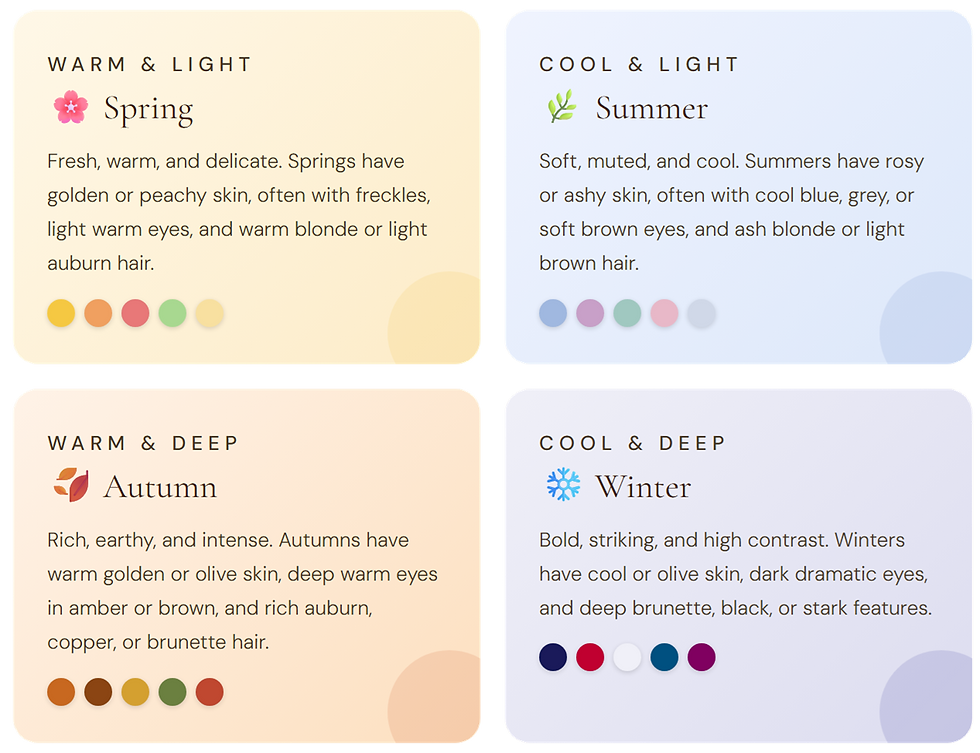
Traditional color analysis organizes personal coloring into four seasonal categories, Spring, Summer, Autumn, and Winter, each with its own distinct palette. Many modern systems expand these into twelve or more sub-seasons, or in-between seasons, for even greater precision, such as the Korean system I learned and practice from my training in Seoul. But understanding the four core seasons is a beautiful place to begin.
05 How the Analysis Works
A professional color analysis session is a personalized, in-depth experience. It's not done with an app or a quiz, it requires trained eyes, proper lighting, and the use of fabric drapes in a wide range of colors placed near your face to observe how your natural features respond in real time.


06 Color Analysis & Your Makeup
Color analysis doesn't stop at your wardrobe, it extends directly into your makeup. Knowing your season helps you choose foundation undertones that actually match, blush shades that mimic your natural flush, lip colors that feel like a more beautiful version of you, and eyeshadow palettes that make your eye color truly sing. It removes the trial and error from the makeup counter and replaces it with intention and confidence.
As both a certified color analyst and a professional makeup artist with over twelve years of experience, I bring both worlds together in every service I offer. When your skincare is dialed in, your colors are identified, and your makeup is chosen with all of that in mind, the result is a look that doesn't just turn heads, it tells your story. Beautifully, authentically, and completely.
If you've ever wondered why some colors make you feel alive and others leave you flat, a color analysis will answer that question once and for all. It's one of the most personally meaningful beauty experiences you can invest in, and I would love to guide you through it.
